 Skip to content

Memory reconsolidation is a brain-based process that allows old stress responses and survival patterns to be updated at a neurological level. It is not about forgetting or reliving the past. It is about giving your nervous system a new experience, one where it no longer needs to hold on. For people with chronic and complex illness, this process can be a quiet turning point.
Why are so many people still stuck, even when they are doing everything right?
This is one of the questions I sit with most as a practitioner.
Someone has done the research. They have tried the protocols, the supplements, the breathwork, the pacing. They are genuinely committed. And yet, something keeps pulling them back to the same place: the same level of reactivity, the same ceiling on their energy, the same fear patterns around symptoms.
It is rarely a willpower problem.
More often, it is a nervous system problem. Specifically, the system is still operating from an old set of instructions, a deeply held pattern that was laid down in response to stress, threat, or overwhelm, and that has not yet been given the signal that it is safe to update.
This is where memory reconsolidation becomes one of the most important concepts in recovery for chronic and complex illness.
What memory reconsolidation is and how it works
Memory reconsolidation is the brain's innate mechanism for updating an existing memory after it has been retrieved. When a memory is brought to the surface and met with a clearly different experience, the brain can revise the original neural encoding instead of layering a new memory on top of the old one.
The phenomenon was demonstrated definitively in 2000 by neuroscientists Karim Nader, Glenn Schafe, and Joseph LeDoux at New York University. In their landmark paper in Nature, they showed that an established fear memory, once reactivated, returns to a labile state in which it can be altered before it restabilises. This finding overturned the long-held assumption that consolidated memories are fixed, and opened the door to an entirely new way of thinking about therapeutic change.
Bruce Ecker and Sara Bridges later translated the neuroscience into clinical practice. Writing in the Clinical Social Work Journal, they describe a sequence of three conditions the brain itself requires:
- Reactivation of the old learning, so the relevant neural pattern is brought online
- Mismatch, a clearly different experience that contradicts what the old pattern expected
- Repetition of the mismatch, so the new learning takes hold
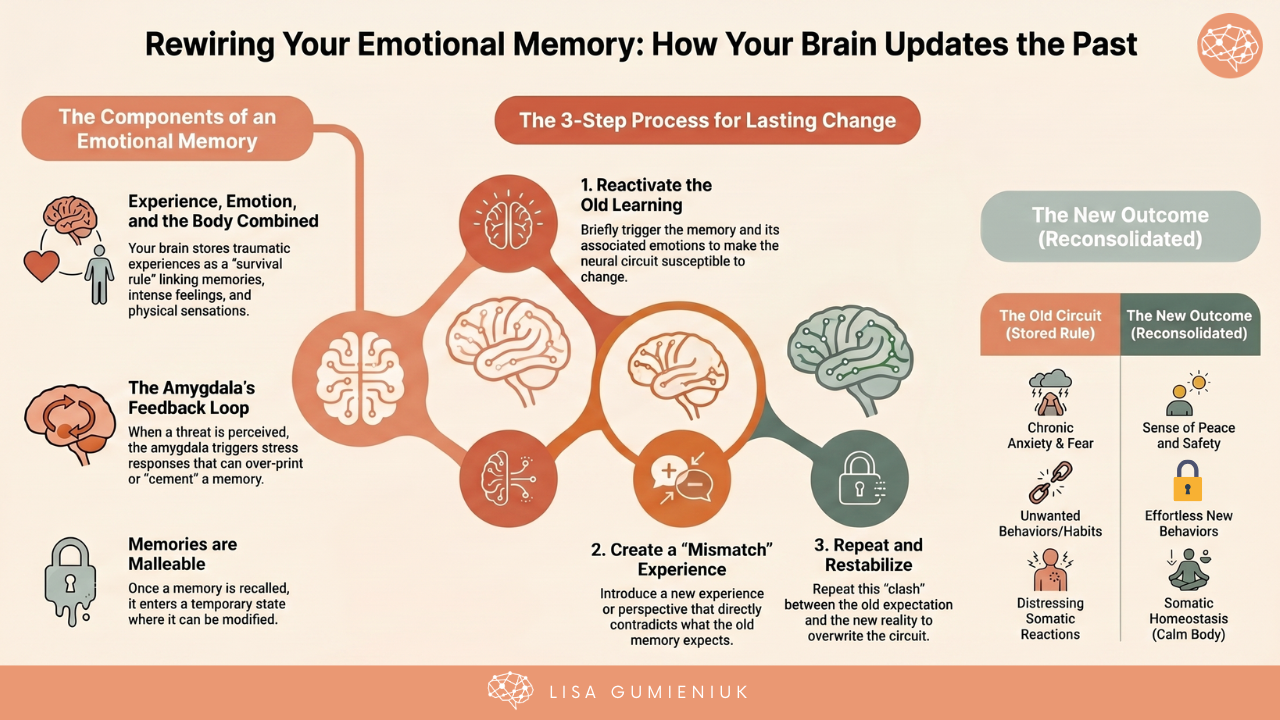
When all three are present in a paced and resourced way, the original learning can be genuinely updated. Put simply: when a pattern is retrieved and held in a state of safety rather than threat, the brain can write a new ending.
This is different from extinction or coping. Extinction adds a new "safe" memory alongside the old one, but the old pattern is still there, ready to return under stress. Reconsolidation, by contrast, allows the original pattern itself to be revised at the level of neural encoding. Researchers describe this as one of the reasons reconsolidation-based work tends to produce more durable change with less relapse than exposure alone.
"What clients often describe as 'something finally shifted' is the felt experience of memory reconsolidation. The pattern that was running in the background is no longer running with the same intensity."
Lisa Gumieniuk Nervous System and Somatic Trauma Coach and PractitionerEvidence-Based EFT (EBEFT) Trauma Practitioner
Sydney, Australia
How is this different from just positive thinking or distraction?
This is an important distinction, and it matters for people with sensitised nervous systems.
Positive thinking, affirmations, and distraction techniques work at the level of the cortex, the thinking brain. They can be useful for managing how you interpret an experience in the moment. But they do not reach the deeper survival circuitry where chronic illness patterns often live.
Memory reconsolidation is different because it works at the level of the amygdala and the deeper limbic system, the parts of the brain that hold emotional memory and run protective responses automatically, below conscious thought.
The key is not effort or belief. The key is creating the right conditions for a mismatch experience, a moment where the nervous system expects one thing (danger, pain, collapse) and instead receives something genuinely different (safety, completion, connection).
When that mismatch occurs in the right context, the old pattern does not just get suppressed. Research suggests it gets updated at a synaptic level, what researchers call depotentiation of the neural pathway. The pattern that drove the response loses its charge.
What does this have to do with EFT tapping and somatic work?
A great deal, as it turns out.
A 2025 review by David Feinstein in Frontiers in Psychology mapped out how EFT tapping protocols appear to facilitate memory reconsolidation. The proposed mechanism goes like this: when a person holds a distressing memory in mind while simultaneously receiving the calming input of tapping on acupressure points, the brain receives a contradictory signal. The old emotional response (the fear, the contraction, the bracing) does not match the physiological calm being created by the tapping.
That mismatch is precisely what opens the reconsolidation window.
Tapping on acupressure points helps regulate brain areas involved in stress and trauma, calms the autonomic nervous system, lowers cortisol levels, activates the prefrontal cortex, and supports memory reconsolidation, all of which work together to reduce emotional distress and rewire the brain's response to stress.
Somatic approaches and parts work (such as Internal Family Systems) operate through a similar mechanism. When a protective part of the system is met with curiosity and warmth rather than resistance, and when the body is held in a regulated, resourced state during that contact, the conditions for reconsolidation are present. The nervous system receives new information: this is safe. I do not need to protect like this anymore.
What I have found in my own practice is that reconsolidation does not require you to tell the story or relive the details. It requires the nervous system to have a genuinely different experience in the presence of the old material. That is why safety is not an optional extra in this work. It is the mechanism.
Modalities that engage memory reconsolidation
Several body-based and trauma-informed modalities are recognised as creating the conditions the brain needs for memory reconsolidation to occur. Each uses a different entry point, but the underlying mechanism is the same: activate the old pattern, introduce a clear mismatch, and allow the brain to update the encoding.
- EFT (Emotional Freedom Techniques) tapping: combines acupoint tapping with verbal acknowledgement of the memory or feeling, creating a mismatch between the activation and the body's regulated state
- EMDR (Eye Movement Desensitisation and Reprocessing): uses bilateral eye movements alongside memory reactivation to update traumatic memory networks
- Brainspotting: uses fixed eye position to access and process subcortical material held in the body
- Havening Techniques: uses specific patterns of touch on the arms, face, and hands to shift the encoding of distressing memories
- Somatic Experiencing and somatic processing: works with the body's incomplete survival responses, allowing them to complete and integrate
- IFS-informed parts work: engages protective and wounded parts of self in a way that meets reconsolidation conditions
Not all of these have the same depth of research evidence directly linking them to memory reconsolidation. EFT and EMDR have the strongest direct research base. The others are theoretically aligned with the reconsolidation framework and widely used in trauma-informed clinical practice.
In my own work, I draw from EFT, EMDR-style eye movement work, Brainspotting, somatic processing, and IFS-informed parts work depending on what each client's system is ready for. The choice of modality is bioindividual. The mechanism underneath is the same.
What does this look like in practice?
I want to share two examples from my practice (both anonymised, with details adjusted to protect privacy) because I think they illustrate something words alone cannot fully capture.
When the body chooses what it is ready to release
I had a client who had been living with chronic fatigue, along with a picture of co-infections and multi-system symptoms. They had been working on their recovery for some time and had reached a plateau, sitting at around 25 to 30 percent capacity for quite a while, unable to move beyond it despite consistent effort.
We were not following a set agenda in this session. We followed something that arose naturally, something that felt intentional even before I had named it. A thread came up that connected to previous sessions and brought something significant to the surface.
I asked the question I often ask: What does this remind you of?
We followed that thread with care.
Towards the end of the session, I invited them into a body-attuned state, a place of genuine inner quiet, and asked them to notice what was happening in different parts of their system. Their immune system. Their cells. The quality of energy moving through them.
They said: My cells feel open. I want to keep them that way.
At the end of the session, before we had even closed, they said: I think I am healing. I feel like I am at about 40 percent.
That shift, from 25 to 40 percent, did not come from a new protocol. It came from the system arriving at a place where it felt safe enough to release what it had been holding.
When the body keeps the score and decides it is ready
In another session, something similar happened, though quite unexpectedly.
A client arrived and, without either of us planning it, their system simply began moving. Something in them recognised the container as safe, the relationship as consistent, and the work as something their nervous system could trust. Their body, as I sometimes put it, had been keeping the score, tracking everything, weighing the safety, and it decided: I know what this is. I am ready. I do not want to hold onto this anymore.
There was a release that was profound, and unexpected, and exactly what was needed.
What I find notable about moments like this is that they are not manufactured. The practitioner does not force them. The client does not will them. The nervous system moves when the conditions of safety, trust, and readiness align. Memory reconsolidation, in its most felt sense, is exactly this.
Why does safety matter so much for this process to work?
Memory reconsolidation has been shown to be more durable than extinction training. Extinction does not actually eradicate old learning. It inhibits it with a neurologically distinct new learning that competes with it. Memory reconsolidation, on the other hand, is believed to transform or completely depotentiate the neural pathways supporting outdated learnings.
But reconsolidation cannot occur if the system is in a state of high activation or overwhelm. The window requires a particular condition: the memory or pattern must be retrieved, but the person must remain within their window of tolerance, regulated enough to receive new information, not flooded.
This is why trauma-informed pacing is not a nice-to-have. It is what makes the biology possible.
For people with chronic and complex illness, whose systems are often highly sensitised, whose threat response is finely tuned, and who have frequently been pushed past their capacity by well-meaning approaches, working within the window of tolerance is not going slowly. It is going effectively.
Building safety first is not a detour around healing. It is the pathway itself.
The reconsolidation window and why post-session care matters
Inside a session, the conditions for reconsolidation are created. The old pattern is activated, met with a mismatch experience of safety or completion, and the new learning begins to take hold. This is where the work itself happens.
What many people do not realise is that the work is not finished when the session ends. Neuroscience research shows that after a memory is reactivated, the brain enters a sensitive period lasting approximately five to six hours, during which the new learning is still being consolidated into stable form. During this window, the new neural encoding is malleable. It is laying itself down. And it is also vulnerable to being disrupted.
This is why the hours after a session matter. Re-entering high-stress situations, rehearsing the old story, scrolling through triggering content, or pushing yourself into activation can interfere with the new learning before it has settled. The goal during this window is to protect what has just shifted, not to test it or override it.
A few practical anchors during this window:
- Reduce exposure to known stressors and conflicts where possible
- Avoid intense problem-solving or replaying difficult conversations
- Drink water and eat something that nourishes your system
- Allow yourself to rest, walk, or do something low-stimulation
- If you feel emotionally tender or fatigued afterwards, this is a normal part of integration
This is one reason I include post-session guidance for every client, and why I do not recommend stacking back-to-back sessions for sensitised systems. The state of the nervous system after a session is part of the work, not separate from it.
Does this mean I have to process my trauma to recover?
No. And this is one of the most important things I want people to hear.
Reconsolidation does not require you to excavate your history, relive difficult experiences, or know exactly where a pattern came from. What it requires is that the pattern is activated in some form, brought into the present with care, and that the system then receives a genuinely different experience.
That can happen through EFT tapping, through somatic work, through parts work, through Brainspotting, through a carefully held coaching conversation. It can happen through the quality of the practitioner relationship itself, which provides co-regulation, attunement, and consistent safety over time.
The healing does not need to be dramatic. In fact, for sensitised systems, the quieter the better.
What the research shows
The research connecting memory reconsolidation to clinical change has come from neuroscience, trauma, pain science, and energy psychology. A few high-quality papers stand out.
The discovery itself sits in Nader, Schafe and LeDoux's 2000 paper in Nature, which demonstrated that consolidated fear memories, once reactivated, return to a labile state in which they can be altered. This is the paper that opened the door to everything that followed.
Ecker and Bridges (2020) in the Clinical Social Work Journal describe how the neuroscience translates into therapeutic practice, and propose memory reconsolidation as a unifying mechanism behind transformational change across multiple therapy modalities.
A 2021 systematic review and meta-analysis in Translational Psychiatry analysed twenty-five randomised controlled trials of consolidation and reconsolidation interventions for PTSD, finding a large effect on PTSD symptoms across treatment trials.
Solomon and Shapiro (2008) in the Journal of EMDR Practice and Research describe how EMDR's adaptive information processing model fits with the neuroscience of memory reconsolidation, framing EMDR as a process of memory updating rather than memory extinction.
A 2025 review by David Feinstein in Frontiers in Psychology examined the physiological mechanisms behind acupoint tapping and proposed that EFT, when delivered well, fulfils the conditions required for memory reconsolidation.
Zhang and colleagues (2023) in Science Advances identified the synaptic mechanism by which reactivated pain pathways can be destabilised and updated, framing chronic pain through the lens of memory reconsolidation. For broader EFT evidence across conditions, the Evidence Based EFT research catalogue collates clinical studies organised by topic.
What I see consistently in my own work is that when sessions create the conditions for reconsolidation, and when the post-session window is honoured, the change tends to hold.
"Memory reconsolidation is the brain mechanism that allows old patterns to be revised, not just managed. For people recovering from chronic illness, this is the difference between learning to cope with the same nervous system and creating real, lasting change inside it."
Lisa Gumieniuk Nervous System and Somatic Trauma Coach and PractitionerEvidence-Based EFT (EBEFT) Trauma Practitioner
Sydney, Australia
Frequently asked questions
Is memory reconsolidation scientifically supported?
Yes. Research into memory reconsolidation has been accumulating since the early 2000s, with initial findings from animal studies and now a growing body of evidence in human neuroscience. Studies using neuroimaging have begun to map how reconsolidation processes occur in the brain, including in the amygdala and hippocampus, which are central to emotional memory and the stress response.
Do I need to remember the original trauma for reconsolidation to work?
Not necessarily. Reconsolidation can work at the level of patterns, protective responses, and body-held stress, not only explicit autobiographical memories. Many people with chronic illness find that the body holds patterns from experiences that were never consciously labelled as traumatic. The work can reach these patterns without requiring excavation of the past.
How is this different from standard CBT or talk therapy?
Cognitive approaches work primarily at the level of thought and interpretation, which engages the cortex. Reconsolidation-based work, by contrast, targets the subcortical emotional memory systems, the parts of the brain that run survival responses automatically. This is why many people find that understanding their patterns does not change them, while somatic and body-based approaches can shift something that thinking alone could not reach.
How long does reconsolidation take?
There is no single answer. Some shifts are noticeable within a session, as in the examples above. Others accumulate over weeks or months of consistent, safe practice. The nervous system moves at its own pace, and that pace is worth respecting. Forcing or rushing the process typically activates more protection, not less.
Can I support this process between sessions?
Yes. Consistent, regular EFT practice builds the same internal conditions, a calm physiological state held alongside activated material, that support reconsolidation over time. This is one of the reasons I place so much emphasis on a regular tapping practice, not just tapping in moments of crisis.
What if I have tried therapy before and it did not work?
This is a very common experience among people with chronic illness, and it makes complete sense. Not all approaches work with the nervous system in the same way. Some create more activation than resolution. The key is finding an approach that works within your window of tolerance, with a practitioner who understands pacing, sensitisation, and the specific demands of complex illness recovery.
Memory reconsolidation is not a technique. It is a biological process that becomes possible when the nervous system feels safe enough to receive new information. For people with chronic illness, this means that safety, trust, and consistent pacing are not just supportive. They are the very conditions that allow healing to occur at a neurological level.
Sources
Nader, K., Schafe, G.E. & LeDoux, J.E. (2000). Fear memories require protein synthesis in the amygdala for reconsolidation after retrieval. Nature. View study
Ecker, B. & Bridges, S.K. (2020). How the Science of Memory Reconsolidation Advances the Effectiveness and Unification of Psychotherapy. Clinical Social Work Journal. View study
Astill Wright, L., Horstmann, L., Holmes, E.A., Bisson, J.I. (2021). Consolidation/reconsolidation therapies for the prevention and treatment of PTSD and re-experiencing: a systematic review and meta-analysis. Translational Psychiatry. View study
Solomon, R.M. & Shapiro, F. (2008). EMDR and the adaptive information processing model: potential mechanisms of change. Journal of EMDR Practice and Research. View study
Feinstein, D. (2025). How tapping works: physiological and psychological mechanisms in energy psychology. Frontiers in Psychology. View study
Zhang, H., Rodriguez-Hernandez, L.D., D'Souza, A.J., et al. (2023). Nociceptor activity induces nonionotropic NMDA receptor signaling to enable spinal reconsolidation and reverse pathological pain. Science Advances. View study


