 Skip to content
Where to Start When You've Tried All the Things
And what to do if you're stuck, or you've been at this for a long time. A safety-first, nervous system led way to think about your next step, grounded in neuroplasticity and recovery, whatever your diagnosis, symptoms and experience.
Lisa Gumieniuk|Nervous System and Somatic Trauma Coach & Practitioner|Sydney, Australia · Worldwide & Online
This applies to you, whatever your label
What I am sharing here isn't tied to a single diagnosis. It works at the level underneath the labels, the nervous system and the protective state it has learned to live in. So whether you have one of these, several, or none of them, the same principles apply.
And if your label or diagnosis isn't listed here, it still applies to you.
Different names, often the same underlying pattern.
A brain and nervous system stuck in protection, doing exactly what it was built to do, waiting to be shown it's safe to stop.
There's a particular kind of tired that comes from trying everything
Not just the tired in your body. The tired underneath it. The one that comes from years of hope and research and protocols and programmes. From being the most informed person in the room about your own condition, and still waking up not knowing what to actually do today.
I know that tired. I saw over 120 practitioners before anyone could tell me what was happening in my body and give it a diagnosis. And even once I had names for it, the treatments brought little to no change. It was years before I worked out for myself that so much of it was nervous system and safety related. In the meantime I became a compulsive researcher. Always seeking, always hoping, always overwhelmed.
So if you're reading this from somewhere on that spectrum, whether you're just beginning, whether you've been at this for years, or whether you're sitting in the particular ache of "I've done all the things and I'm still here," this is for you.
I want to offer you a way to think about where you are, and where to go next, that doesn't ask you to push harder.
Wherever you are, start here
First, the reframe that changes everything
Most of us arrive at brain retraining and nervous system work after we've already tried to fix the body directly. Diets, supplements, protocols, treatments. Those things have their place.
But here's what I wish someone had told me earlier.
Your symptoms are not a sign that you're broken. They're a sign of a system doing exactly what it was built to do, in the conditions it has been living in. A nervous system stuck in protection isn't malfunctioning. It's protecting. It just hasn't been shown that it's safe to stop yet.
This matters for where you start, because it changes the question.
- The old question was "what's the next thing to fix?"
- The better question is "what does my nervous system need to feel safe enough to change?"
When I stopped chasing fixes and started creating the conditions my body needed to feel safe, that's when things began to shift.
1. If you're just starting
If you're new to this, the most useful thing I can tell you is that the order matters more than the intensity.
A lot of people come in and try to do all of it at once. Every tool, every practice, every protocol they've read about, stacked on top of a system that's already overwhelmed. And it doesn't land, because the nervous system reads "more" as "more pressure."
- Less is more. Pick one small thing that helps your body feel even slightly safer, and let it be consistent rather than heroic.
- Repetition beats effort. Neuroplasticity, the brain's ability to learn new patterns, runs on repetition, not force. Small and steady builds new pathways.
- Safety first, always. A good tool taken into an overwhelmed system often doesn't land. Regulating first isn't a detour from the work. It's the pathway.
If you want a foundation to build on, my free course It's Real walks through why the nervous system sits at the centre of chronic illness and recovery, in a way that's designed for an overwhelmed system to actually take in. It's the context that makes everything else make sense. The free Mountain Journey Assessment is also a lovely place to begin, because it helps you see where you actually are before you take a step.
2. When you understand your nervous system, but nothing changes
This part is for the people who know their stuff. You can explain polyvagal theory to your GP. You understand neuroception and the cell danger response. You've read Dr Stephen Porges and Dr Robert Naviaux's work. You've watched the approaches, you know the language, and a quiet voice still asks: so why isn't this shifting for me? You've tried the allowing method, maybe even trauma work, and you've done the programmes. You've been accumulating programmes like they're going out of fashion.
Here's something I see all the time. There's often a missing piece to the puzzle. And it's usually not about doing all the things. It's about doing the right things, at the right time, in sequence, and in a way that's safe for your nervous system.
Understanding regulation is not the same as being regulated. The shift happens in the body, in the felt sense, not only in what you know.
There can be a gap between knowing a concept and your body actually living it. You can understand safety as an idea and still not have a felt experience of it in your nervous system. The information is in your head, but the nervous system changes through experience, not explanation.
So if you're educated about all of this and still stuck, you're not missing information. You may be missing the embodiment, the part where the concept becomes something your system has actually felt, repeatedly, until it believes it. Or maybe one of the recovery pathways is missing for you. That's a different kind of work, and it's often the piece that's been missing.
3. If you're stuck or you've tried everything
This is the hardest place, and the one I get asked about most. When you've genuinely tried everything and you're still here, it's easy to land on "maybe it's me, maybe I'm the exception, maybe I'm just too broken." I want to name that thought, because so many people carry it silently.
You're not the exception. You're a person whose nervous system hasn't yet had the specific conditions it needed.
If you're further along, the thing I'd offer first is a quiet audit. Not of what you're doing, but of how your system is while you're doing it. You can do all the right practices from a state of striving, of "I have to get this right or I'll never get better." And that underlying state is itself a signal of threat. The body can't fully settle while it's bracing.
A few things I've seen make the difference when someone feels stuck:
- You may have been working top-down. Thought, willpower, and reframing, when your system needs bottom-up, starting with the body and the felt sense first. The cognitive shift tends to follow the body, not lead it.
- You may have been doing the work alone. Co-regulation, the way our nervous systems settle in the presence of other regulated systems, is a real physiological process, not a nice extra. Some systems can't get there in isolation.
- The pace may have been too fast. Sometimes "stuck" means the work was moving too quickly for a sensitised system, and what looks like a plateau is actually a system asking for more safety before it can go further.
- A pathway may be missing. Recovery isn't one road. Sometimes "stuck" is a sign that one of the recovery pathways hasn't been part of your picture yet.
- You may need a different kind of guide. Sometimes the missing piece is a coach or practitioner who has been in this space for years and can hold steady while your system finds its way through.
I'll say something carefully here, because I see it far too often. People come to me after working with very well-meaning coaches who have been through their own recovery, but who don't have the training or experience to hold space for trauma. When someone doesn't understand the fundamentals of traumatic experience, the message can quietly become "you just need to do this" or "you just need to push through." For a sensitised, trauma-affected system, that isn't the right thing, and it can set people back. The right support isn't about doing more. It's about being met by someone who understands what your nervous system is actually carrying.
When techniques aren't landing, look at the sequence
Here's something I'd really like you to know. If the techniques you're trying aren't working or aren't landing for you, it usually isn't because the techniques are wrong, and it almost never means you're doing it wrong.
When a tool isn't landing, there's often a sequencing issue underneath it, the right things being done in the wrong order, or a trauma layer that needs to be met with safety and guidance first.
A regulating tool taken into a system that hasn't yet found enough safety often can't do its work. The same tool, introduced once the ground underneath is steadier, can land completely differently. This is exactly the kind of thing that's hard to see from the inside, and where an experienced, trauma-informed guide can help you find the order your system actually needs.
And if something in you resists the work, or pulls away from rest even when you know you need it, that's worth understanding rather than overriding. I wrote about why the body sometimes resists healing, because that resistance is information, not failure. If you're not sure whether your current capacity is the issue, this piece on the window of tolerance is a useful place to look.
Let's explore a few myths
If you've already tried other recovery approaches, some of these may be quietly shaping how you see your own situation.
The thread running through all of these is the same. Curiosity and compassion, rather than force and self-judgement, are what let a sensitised system feel safe enough to change. Not because it's nicer, but because the nervous system reads pressure as threat, and threat is the opposite of the conditions recovery needs.
Recovery is a pathway, not a protocol
One thing that helped me, and that I share often, is that recovery isn't one road. It happens through pathways, and different pathways suit different people at different times.
A protocol says: do these steps, in this order, and you'll get this result. It assumes everyone's system is the same. A pathway is different. It honours that your nervous system, your history, and what your body is carrying are unique to you, and it lets the work be shaped around that rather than forcing you to fit a fixed sequence.
When we look at neuroscience, polyvagal theory, and psychoneuroimmunology, safety sits at the very foundation of every pathway. So recovery is about finding that safe ground first, then exploring the pathways from there. These are some of the layers a complex, sensitised system often needs, not as a checklist, but as territory you can move through in whatever order your system is ready for.
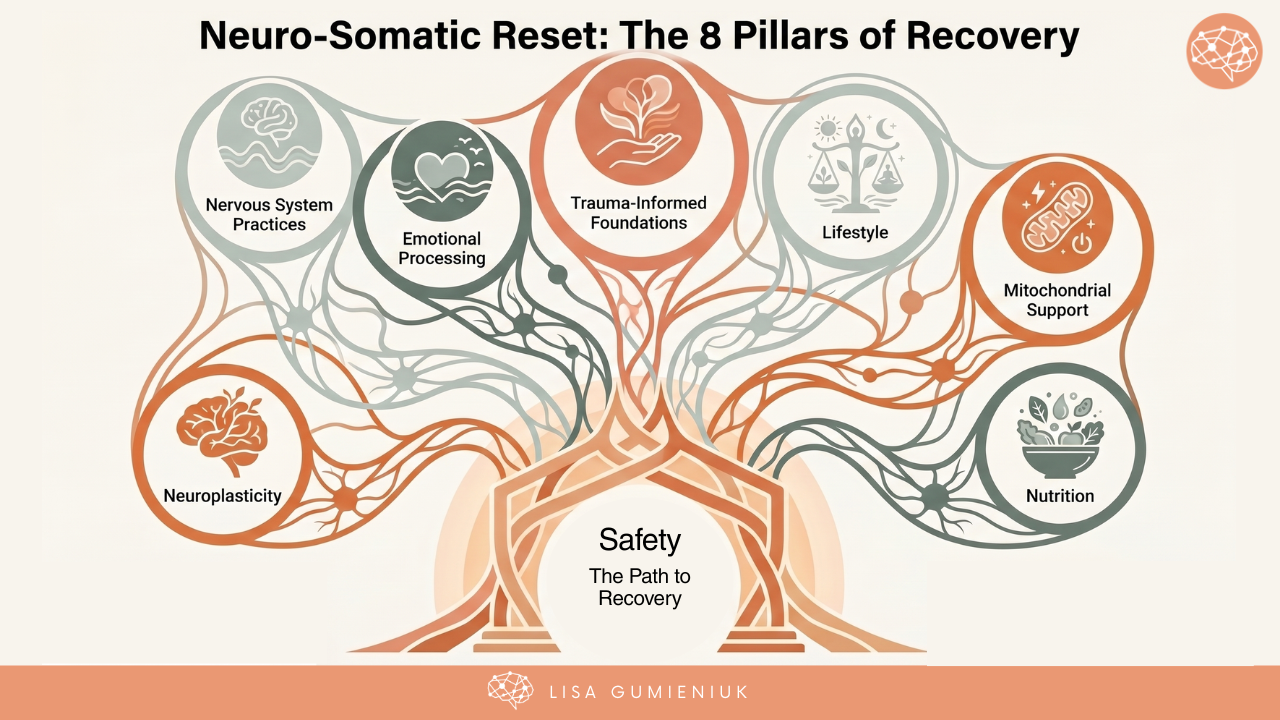
When we look at neuroscience, polyvagal theory, and psychoneuroimmunology, safety sits at the very foundation of every pathway. So recovery is about finding that safe ground first, then exploring the pathways from there.
Foundations of safety
Before anything else, the nervous system needs to feel safe. This is the ground everything else is built on. Without felt safety, even the best tools struggle to land.
Nervous system regulation
Learning to recognise your states, and to support your system back towards regulation. This is where capacity and flexibility are slowly rebuilt, at a pace your body can hold.
Neuroplasticity and rewiring
Gently teaching the nervous system new patterns through repetition and felt safety, so the old protective loops have room to soften and update over time.
Emotional processing
Letting emotion be acknowledged and moved through the body rather than held or pushed away. For many systems, this is the very thing the brain has been waiting for.
Trauma-informed support
Meeting what the body is carrying with safety and the right sequence, rather than reliving or overriding it. Processing happens at the pace your system can integrate.
Lifestyle and rhythm
Pacing, rest, sleep, and the daily rhythms that either support a settling system or quietly keep it braced. Small, sustainable shifts that the body can actually keep up with.
Cellular and physical support
Honouring that the physiology is real. Mitochondrial, immune, and physical health sit downstream of a sustained protective state, and they matter alongside the nervous system work.
Nourishment and the body
Bioindividual nutrition and support for the gut, the microbiome, and the body's terrain, worked with care for sensitised systems rather than rigid rules.
If one of these pathways has never been part of your picture, that absence can be the very thing that's kept you stuck. Not because you weren't trying hard enough, but because a piece of the puzzle was simply missing.
The first piece is usually learning. Spending time understanding that these are pathways into recovery, and getting to know each one in more detail, is itself part of the work. If you'd like to explore the pathways properly and see how they fit together, that's exactly what we walk through inside Safe Ground.
Are your beliefs getting in the way?
Sometimes the thing quietly blocking recovery isn't a missing technique. It's a belief. "It's not safe to rest." "If I stop pushing, everything falls apart." "My body has let me down." "Other people get better, but I won't." These beliefs sit underneath the work, and the nervous system responds to them whether or not we've named them.
Bringing them into the light is often a key step, because once you can see a belief, you can begin to work with it rather than being run by it. If you'd like a way to surface some of your own core and limiting beliefs, so you have a clearer sense of what to move forward with, here's a free reflection to start with.
One of my favourite bottom-up tools
There are so many tools to choose from, and that's part of what makes this overwhelming. But if you're looking for somewhere practical to begin with the body rather than the mind, the one I keep coming back to, and the one I find people do the best with, is EFT tapping (Emotional Freedom Techniques). It works with the body and the felt sense directly, helps calm the stress response, and lets emotion be acknowledged and processed rather than pushed away.
It's paced, it's something you can do at home in small doses, and it meets a sensitive system softly rather than forcing anything. It also has a genuine and growing evidence base, which you can read more about on my EFT research page. If tapping feels like it might be for you, here's a free EFT tapping resource library to explore in your own time.
What kind of support do you need right now?
Everything we've walked through, the myths worth letting go of, the pathways, the pieces worth exploring, can change your recovery trajectory once you can see them clearly. And how you're supported while you do that work matters just as much as the work itself.
Here's the part I really want you to hear, because I see a lot of people carry guilt and even shame about this, and I'd love to break that stigma.
Maybe you need one kind of support. Maybe you need several. Maybe you need all of it, at the same time, or at different times. That is completely okay. There is no judgement here, and no hierarchy.
So many people get caught up feeling that they should be able to do this on their own, and that needing community or personalised support somehow means they've failed. That's simply not true. I didn't always do it alone myself. At different points in my own recovery I needed all of it, sometimes at once. Reaching for support isn't a sign that you're behind. It's a sign that you're meeting your nervous system where it actually is.
The skill isn't pushing yourself to need less. It's noticing what your system is actually asking for right now, and letting yourself have it.
I want to share these options with you, because some people don't realise there are different paths to begin with. I'm not here to sell you anything. I'm here to support you in whatever path feels right for where you are, even if that's something you do entirely on your own.
Self-led resources
Learning, free resources, and your own daily practices. The things you do on your own, in your own time. This is where a lot of people begin, and it's genuinely valuable.
Community and co-regulation
Being in a regulated, shared space with others walking the same path does something solo work can't, because the nervous system learns safety partly through connection.
Personalised, with a guide
One-to-one, practitioner-led support for systems that are complex, sensitised, or that haven't been reached by more general approaches. Deeper, paced, and shaped entirely around you.
"My brain is responding to situations differently this week. Evidence I can see that I am slowly rewiring those patterns. It makes me feel hopeful for my future."
Julia S · Reset Glimmer
Real People. Real Change.
Proof that recovery is possible
When you've tried everything, words about what's possible only go so far. What helps is seeing real people, with real labels, who found their way through. Nothing has been embellished.
Read more testimonials
A Recovery Story
Henry's Story
Chronic fatigue, head pressure & depression
"For more than 20 years I lived with constant fatigue and nearly 10 years of relentless head pressure. It affected my business, my family life, even my belief that recovery was possible. I believed I might never get better."
Within 8 weeks, everything shifted.
- For the first time, I had tools to regulate my nervous system and meet myself with compassion instead of criticism
- The head pressure reduced from 10/10 to 1/10
- The depression that once pulled me under now feels neutral
- I feel strong, optimistic and connected to life again
"For the first time in decades, I feel amazing."
Different people. Different labels. Real change.
What they share is a nervous system that learned, with the right conditions, that it was safe enough to change.
"For five years, I battled chronic insomnia. I tried everything. DNRS, specialists, acupuncture, supplements. Nothing worked. After 11 sessions, my sleep is 99% better. I finally feel like myself again."
5 years of chronic insomnia. Every night filled with fear and adrenaline.
Sleep 99% better. Travelling, sleeping beside her husband, enjoying social outings.

"I'd tried EFT on my own. I thought it was meant to cure me, and when it didn't, I gave up. What I didn't realise was that it's really about helping regulate my nervous system. In the first week, the shifts were massive."
Months of burning pain from medication. Lying awake in fear. Tried EFT alone but couldn't make it work.
Pain dropped 98%. Using tapping to calm her system at night. "My body wasn't broken."

"I have a much bigger capacity to regulate my emotions, like huge. It felt safe to be vulnerable, and I felt tangible improvements in my body and state of being after every session."
Extreme anxiety, low mood, low self-esteem. Default state: overwhelmed, stressed, reactive, powerless.
Choosing to regulate. Motivated to maintain calm. Substantially more self-empowered.

"My glimmer this week has been being able to re-introduce two vitamin supplements that are very much needed, and my body is accepting them with safety. A huge win for me with MCAS."
A reactive system that couldn't tolerate supplements it needed, common with MCAS.
Re-introducing needed supplements with the body accepting them in safety.
"I noticed my body going into shutdown, gave myself ten minutes of rest plus some tapping, and was able to get up with a clear mind and energy to connect and play. I'm amazed at my body's ability to regulate so quickly."
Overstimulating days ending in shutdown and exhaustion by lunchtime.
Catching shutdown early, resting, and returning to energy and connection.
"I don't relate to the word 'symptoms' anymore, and instead replace it with 'sensations'. Now I feel the difference. It finally clicked. I see it as part of moving away from victim."
Living inside the language of symptoms and a sense of being a victim of the body.
A felt identity shift, relating to the body with less fear and more agency.
The one thing I'd leave you with
Wherever you are on that spectrum, you don't have to push through to get somewhere. That's the old model, and for sensitised systems it often backfires.
You build safety. You build capacity. You go at the pace your system can actually integrate. One step at a time. And the strange, hopeful thing is that the slower, safer path is usually the faster one in the end, because the system isn't being knocked back into protection every time it starts to settle.
So much of recovery is about finding the right piece for your particular puzzle, the key that fits your door. And I want you to know that it is possible, for everybody. There are always options and avenues to explore. So if you're not getting the results you want, that isn't the end of the road. It's an invitation to explore a little further, and to trust your gut and your own knowing as you do.
You are not broken. It's a protective state. And protective states can change, when the system feels safe enough. Sometimes that change is self-led. Sometimes it happens in community, or alongside a guide. There's no single right way, only the way that fits you.
Big love,
Lisa

Meet your guide
Lisa Gumieniuk
Nervous System and Somatic Trauma Coach and Practitioner · Sydney, Australia · Worldwide and Online
I understand this because I lived it.
After years of navigating my own complex health challenges, I discovered what conventional systems missed: the role of nervous system regulation, somatic safety, and brain-body rewiring in recovery.
I bring over a decade of clinical practice, advanced training, and lived experience to every person I work with. This is not theory. It is work I have done myself, and work I continue to refine.
I'm not here to fix you. I'm here to walk with you.
My work brings together nervous system regulation, somatic and trauma-informed practice, neuroplasticity, and EFT tapping, shaped around the person in front of me rather than a fixed protocol. I work with people living with chronic illness, chronic fatigue, chronic pain, sensitivities, MCAS, anxiety, trauma, and nervous system dysregulation, online across Australia and worldwide.
Wherever you are, you can start with one thing
You don't have to have it all figured out to be in the right place. You only need to take one step, and then the next, when you're ready.
Recovery happens in safety. Paced for your capacity.